Short answer
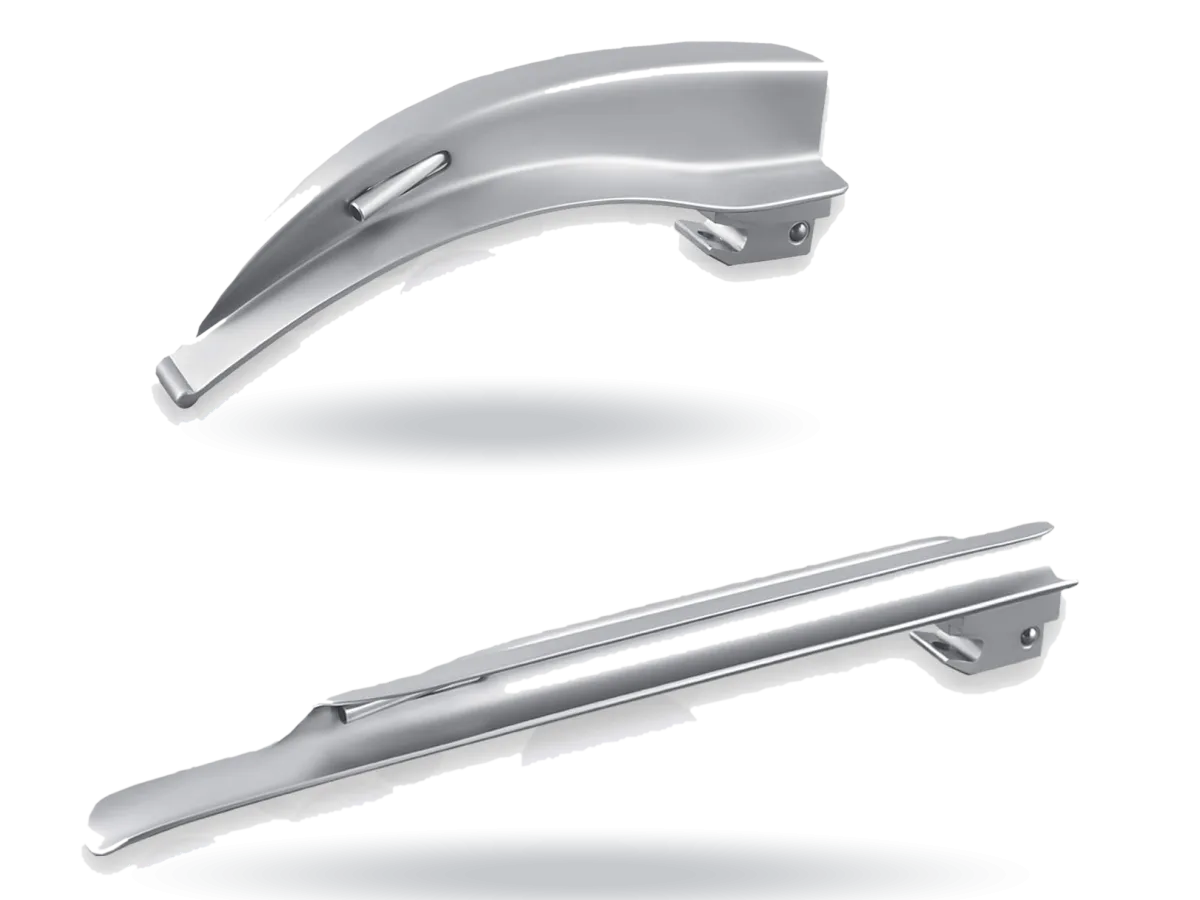
A Macintosh blade is curved. Its tip is placed in the vallecula, in front of the epiglottis, and lifting the blade raises the epiglottis indirectly. A Miller blade is straight with a slight curve near the tip, which is passed beneath the epiglottis to lift it directly.
Macintosh is the most widely used pattern for adults. Miller is often chosen for neonates and infants. Both fit the same handle, provided handle and blade belong to the same light system.
The difference at a glance
| Macintosh | Miller | |
|---|---|---|
| Shape | Curved along its length | Straight, with a slight upward curve near the tip |
| Where the tip goes | Into the vallecula, in front of the epiglottis | Beneath the epiglottis |
| How the epiglottis is lifted | Indirectly, by tension on the tissue that connects it to the base of the tongue | Directly, by the tip of the blade |
| Profile | A tall flange on the left side, used to move the tongue aside | A low, narrow profile that takes up less room in the mouth |
| Often chosen for | Adults and older children | Neonates, infants and young children, and some adult cases |
| Sizes in our range | 00 to 5, from 68 to 175 mm | 00 to 4, from 65 to 205 mm |
| Introduced | 1943, by Sir Robert Macintosh | 1941, by Robert A. Miller |
Macintosh: the curved blade
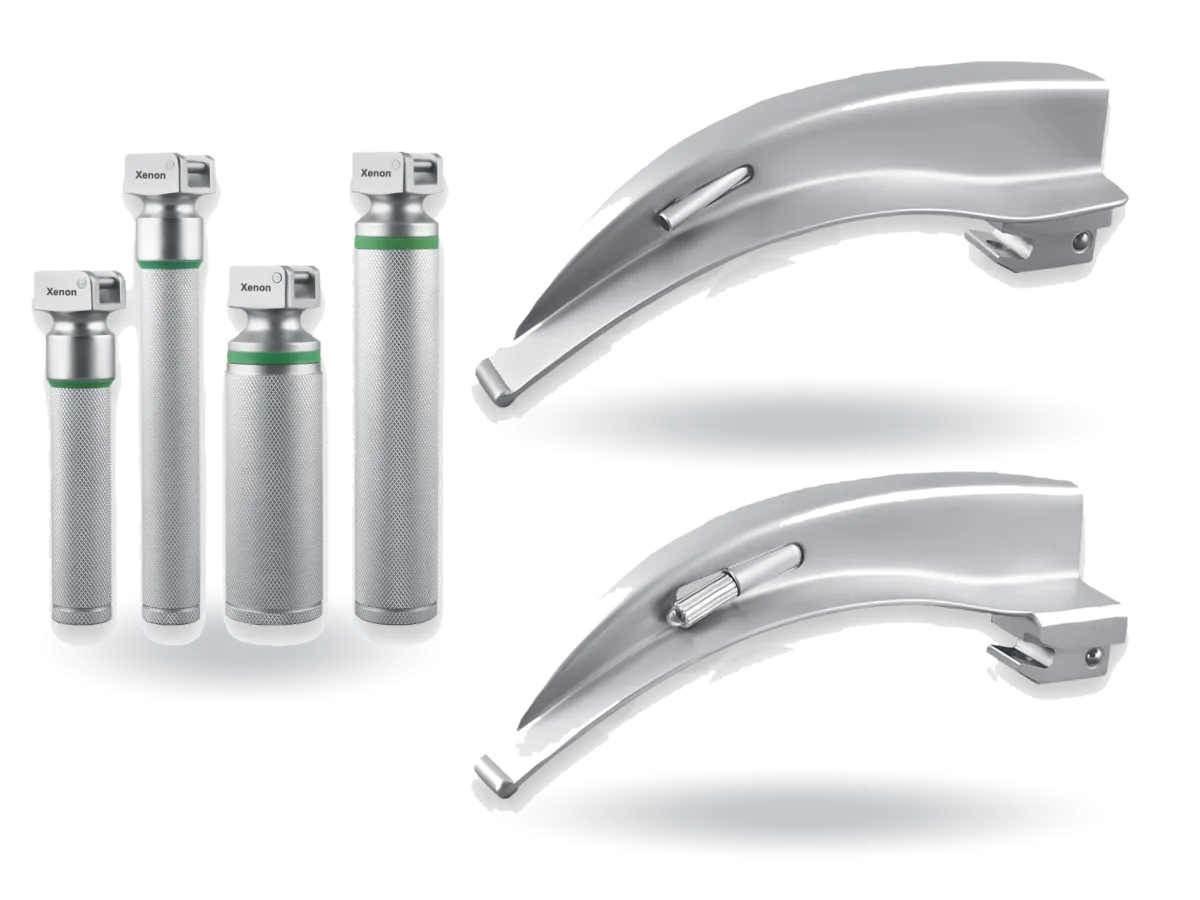
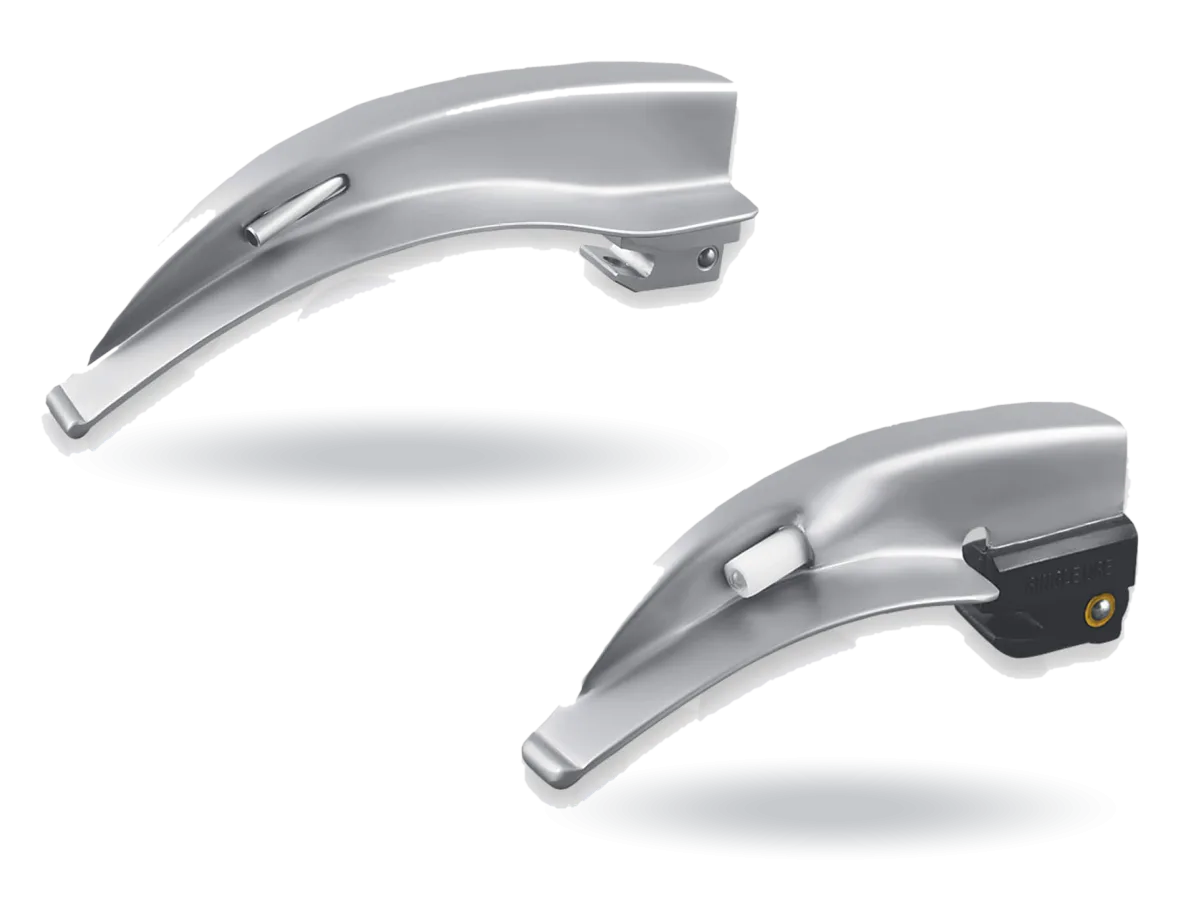
The Macintosh blade curves gently from the handle to the tip. The tip is advanced into the vallecula, the small space between the base of the tongue and the epiglottis. When the clinician lifts the laryngoscope, the tension transmitted to the epiglottis raises it and exposes the vocal cords. The epiglottis itself is not touched by the blade.
The tall flange on the left side keeps the tongue out of the line of sight. This combination of a curved shape and a wide working space is why the Macintosh is the most common pattern in adult anaesthesia and emergency medicine, and the one most clinicians train on first.
The pattern has many variations. Besides the standard English profile, we make the Macintosh American profile, MacFlex and Mega MacFlex blades with a hinged tip, Improved View, Reduced Flange and Mega Line versions. The blade size chart lists the sizes available for each.
Miller: the straight blade
The Miller blade is straight, with a slight upward curve close to the tip. Instead of resting in the vallecula, the tip is passed beneath the epiglottis and lifts it directly out of the way.
In neonates and infants the epiglottis is relatively large and floppy and the larynx sits higher than in adults. Lifting the epiglottis directly often gives a clearer view, which is why Miller blades are widely used in neonatal and paediatric care. Some clinicians also choose them for particular adult patients. The narrow profile needs less mouth opening than a Macintosh blade.
Related straight patterns in our range include Miller American, Miller Oxiport with an oxygen port, Wisconsin, Wis-Hipple, Phillips, Seward and Robertshaw.
Sizes and lengths
Both patterns use the same size numbers, but the same number does not mean the same length. A Miller size 3 is 195 mm long, 60 mm longer than a Macintosh size 3. When you compare offers or fill in a tender, always check the length in millimetres, not only the size number.
Lengths as listed for our reusable English-profile blades. Other patterns and single-use versions can differ slightly; each product page gives the exact length.
Article codes in our range
Both patterns are made for both light systems, as reusable and as single-use blades. The first four digits give the version; the last number is the size. For example, AL-1401-3 is a reusable fiber optic Macintosh, size 3.
| Version | Macintosh | Miller |
|---|---|---|
| Reusable, fiber optic (green system) | AL-1401 | AL-1402 |
| Reusable, conventional lamp | AL-1201 | AL-1202 |
| Single-use, conventional LED | AL-1601 AL-1603 | AL-1602 AL-1604 |
| Single-use, fiber optic | AL-1801 AL-1803 | AL-1802 AL-1804 |
Not every size is made in every version. The blade size chart shows which code exists for each size.
Handles and compatibility
Macintosh and Miller blades do not need different handles. What decides compatibility is the light system. A fiber optic blade needs a fiber optic handle, and a conventional blade needs a conventional handle. Within the same system, a hospital can use Macintosh and Miller blades on the same handles.
Handles also come in different sizes, from slim paediatric handles to standard adult handles. The handle size is a matter of grip and battery capacity, not of blade pattern. Our guide to fiber optic and conventional laryngoscopes explains the two systems.
Planning an assortment
For a distributor, the right mix of Macintosh and Miller blades depends on the hospitals you supply. A few questions settle most of it.
- Which light system do your hospitals use?Settle this first. It decides the handles, and blades from the other system will not work with them.
- Which departments do you supply?Adult theatres and emergency departments mainly use Macintosh sizes 3 and 4. Neonatal and paediatric units use the small sizes, often in the Miller pattern.
- Reusable, single-use or both?Many hospitals now keep single-use blades for some areas and reusable blades for others. See reusable vs single-use blades.
- Loose blades or complete sets?Tenders often ask for sets with a handle and several blades in a case, as well as loose blades for replacement.
- Your brand or ours?If you sell under your own name, see OEM and private label.
Questions
Is a Macintosh blade better than a Miller blade?
Neither is better in general. The two blades work in different ways, and the right choice depends on the patient and on the training and preference of the clinician. Many departments keep both patterns.
Why are Miller blades often used for babies?
In neonates and infants the epiglottis is relatively large and floppy and the larynx sits higher. Lifting the epiglottis directly with the tip of a straight blade often gives a better view. The final choice is always made by the clinician.
Do Macintosh and Miller blades fit the same handle?
Yes, as long as the handle and the blade belong to the same light system. Fiber optic blades need a fiber optic handle, and conventional blades need a conventional handle. Fiber optic vs conventional laryngoscopes
Which Macintosh size is used for adults?
In our range, Macintosh size 3 (135 mm) is listed for medium adults and size 4 (155 mm) for large adults. Sizes 3.5 (145 mm) and 5 (175 mm) are also available. The size for a patient is chosen by the clinician. Laryngoscope blade size chart
This guide describes products and general practice for buyers. It does not replace clinical training or the instructions for use supplied with each device. The choice of device for a patient is made by the clinician.