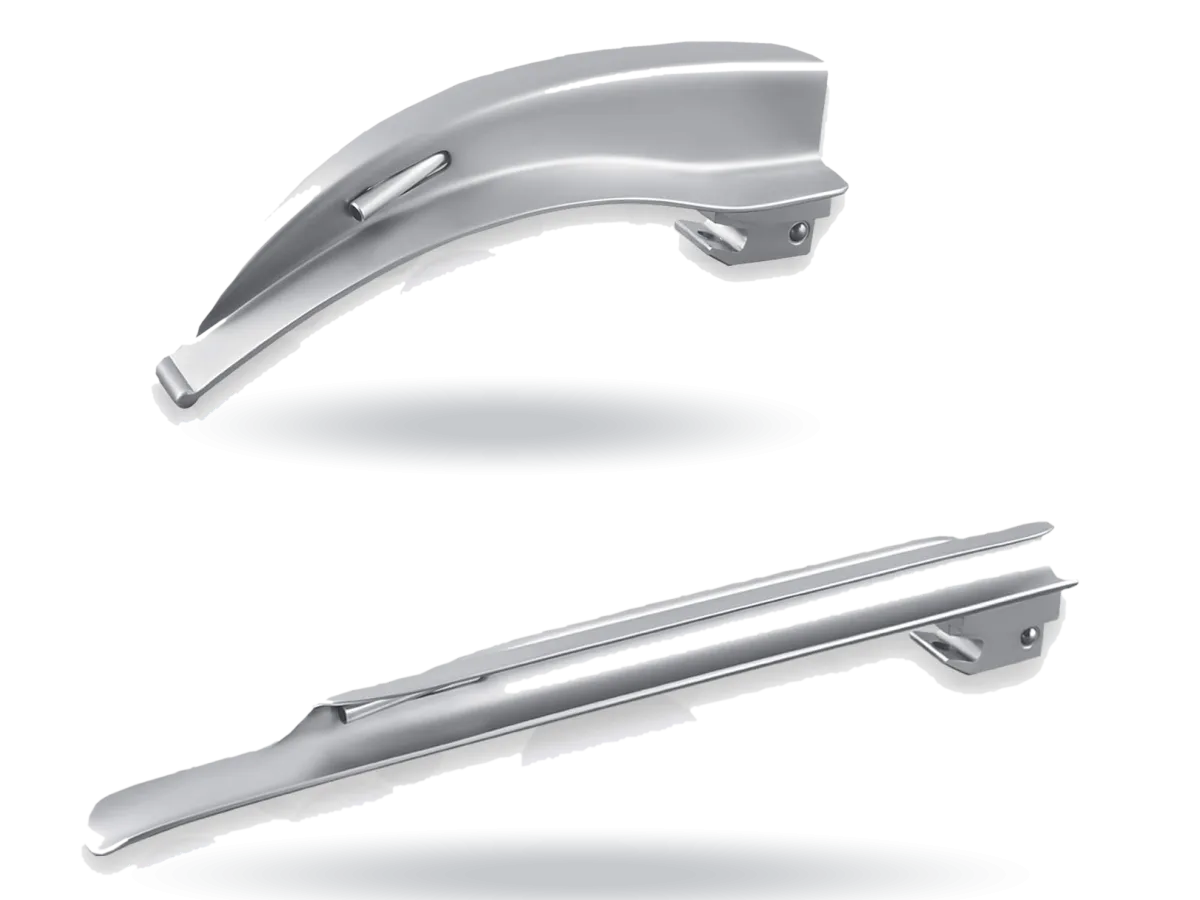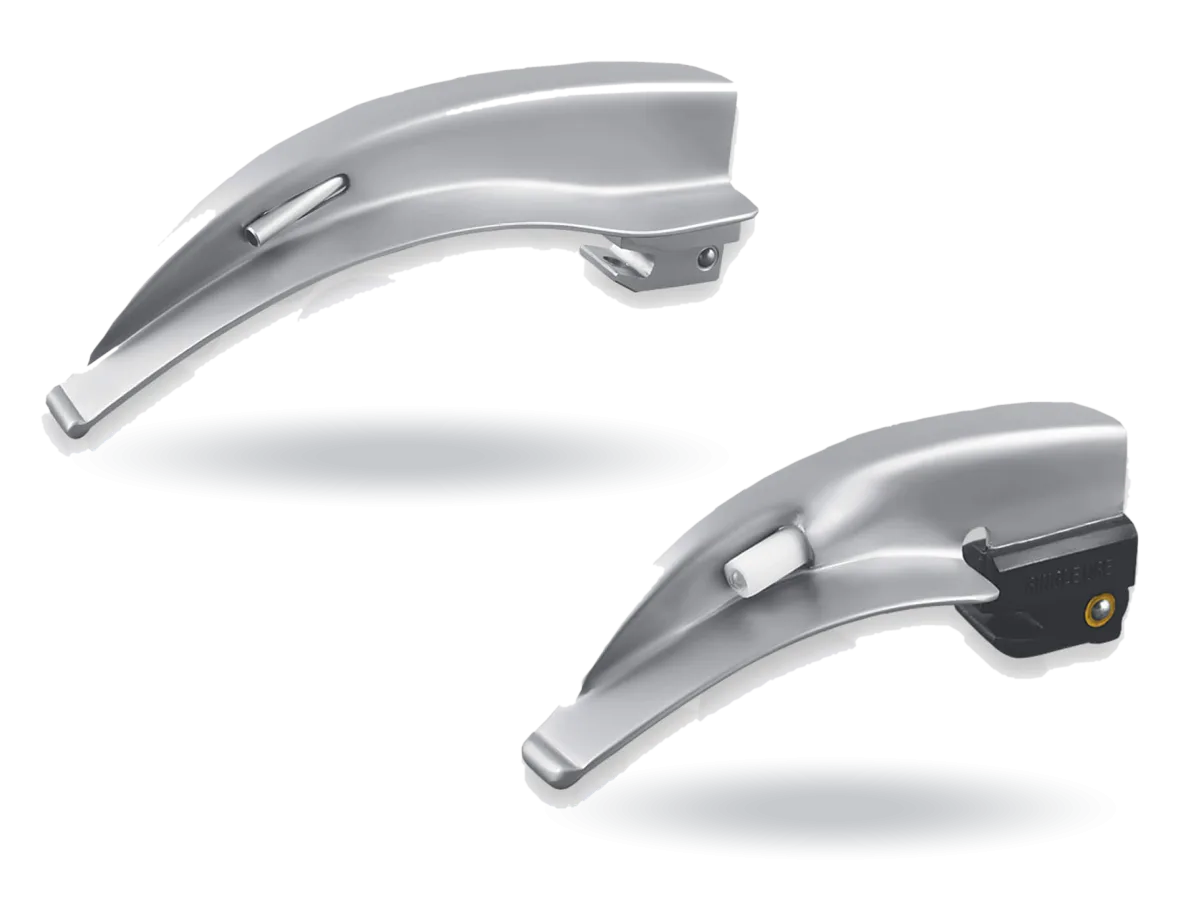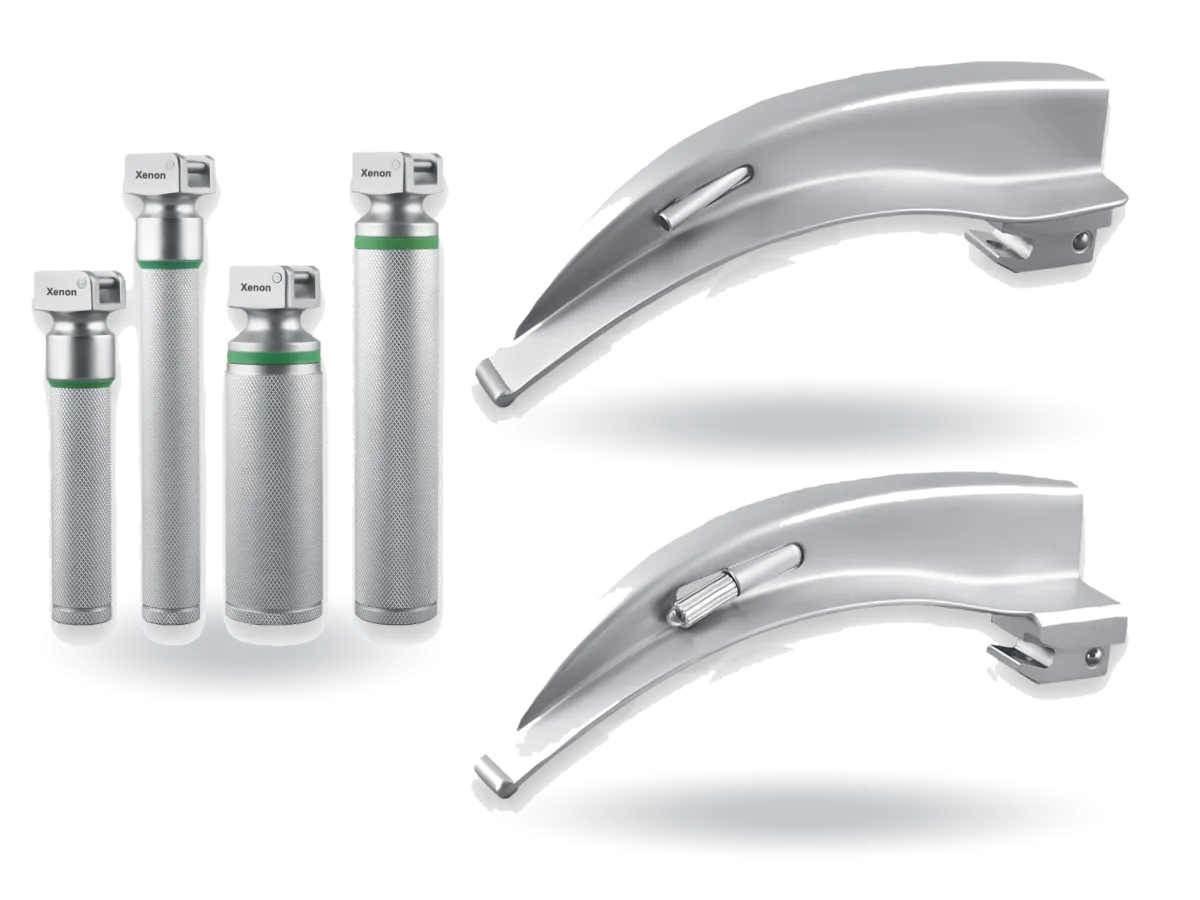
Short answer
In a conventional laryngoscope, the lamp sits on the blade and is powered through an electrical contact with the handle. In a fiber optic laryngoscope, the lamp sits in the handle and the light travels to the blade tip through a light guide.
Fiber optic blades carry no lamp and no electrical parts, which makes them simpler to reprocess. The two systems do not mix: a fiber optic blade needs a fiber optic handle, and a conventional blade needs a conventional handle.
How each system works
Both systems use the same basic design. Batteries sit in the handle, the blade hooks onto the top of the handle, and the light switches on when the blade is opened into its working position. The difference is where the lamp is.
Conventional
The lamp is mounted on the blade, close to the tip. When the blade clicks into its working position, a contact on the handle meets a contact on the blade and closes the circuit, and current from the handle batteries runs through the blade to the lamp. Older blades use small screw-in bulbs; newer ones increasingly use LED lamps.
Fiber optic
The lamp sits in the head of the handle. When the blade is opened, the lamp switches on and shines into the base of the blade, where a light guide carries the light to the tip. Reusable blades usually use a bundle of fine glass fibers; many single-use blades use a moulded acrylic light guide instead. The blade itself has no lamp, no wiring and no electrical contact.
Side-by-side comparison
| Fiber optic (green system) | Conventional | |
|---|---|---|
| Where the light is made | Lamp in the handle | Lamp on the blade |
| What the blade carries | A light guide: glass fibers or acrylic | A lamp, a contact and a conductor |
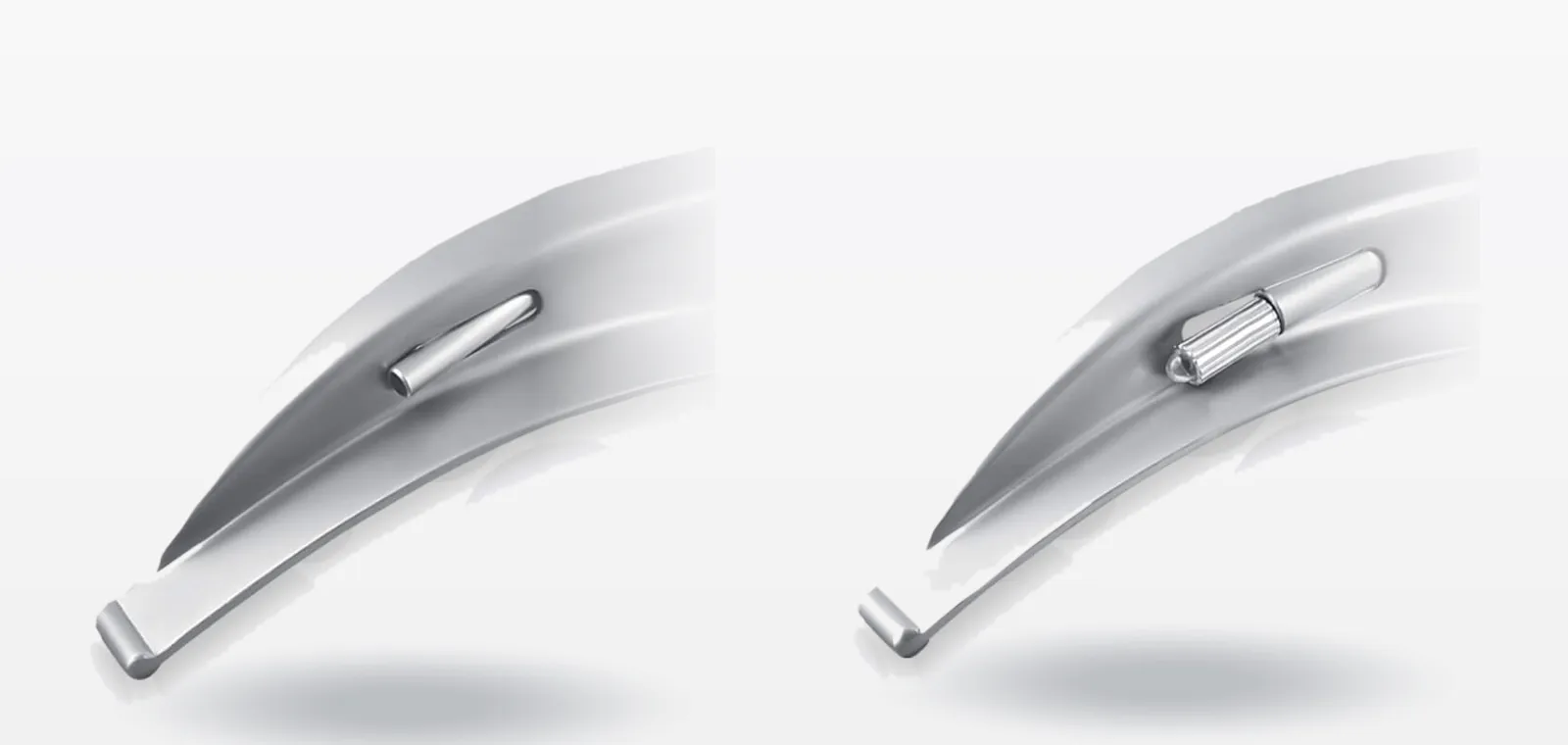
| How to recognise it | Green marking on handle and blade; no lamp near the tip | Small lamp visible near the blade tip |
| Reprocessing the blade | No lamp to remove. Follow the instructions for use | The lamp is usually removed first. Follow the instructions for use |
| Lamps to replace | One per handle | One per blade |
| Handles needed | Fiber optic handles | Conventional handles |
| Codes in our range | AL-14xx reusable, AL-18xx single-use | AL-12xx reusable, AL-16xx single-use LED |
Why the two systems do not mix
A fiber optic handle has a lamp but no contact for a blade lamp. A conventional handle has a contact but no lamp of its own. Put a conventional blade on a fiber optic handle and there is no current for its lamp; put a fiber optic blade on a conventional handle and there is no light to carry. In both cases the laryngoscope stays dark.
This is why the green marking matters on a busy ward or in a theatre store: staff can see at a glance which handles and blades belong together. Within one system, most manufacturers use the same hook-on fitting, so handles and blades from different brands often work together. Even so, check the fit and the light before use, and ask the supplier to confirm compatibility for the brand and model you already have.
Halogen, xenon or LED
The lamp type is a separate choice from the light system. Fiber optic handles are made with halogen, xenon or LED lamps, and conventional blades with small bulbs or LED lamps.
- Halogen gives a warm, yellowish light and is the traditional choice.
- Xenon is a halogen-type lamp that gives a whiter light.
- LED gives a white light, runs cool, uses less battery power and lasts longer than a filament lamp.
When a hospital replaces lamps, it needs the right lamp for its handle model. For distributors, it is worth keeping spare lamps for the handles you sell.
Which system to stock
For a distributor, the decision is rarely made from scratch. Hospitals keep the handles they already have, and new blades must match them. A few practical points:
- Ask what is installed.Before you quote, find out which system and which handle brand each hospital uses.
- Consider reprocessing.Fiber optic blades have no lamp or electrical parts, so many hospitals find them simpler to clean and reprocess.
- Keep both systems in single-use.Single-use blades are made for both systems: fiber optic for green-system handles and LED for conventional handles.
- Stock the spares.Lamps for handles and conventional blades, and batteries, are often reordered with the blades.
Our fiber optic and conventional ranges cover the main blade patterns in all common sizes.
Questions
Can I use a fiber optic blade on a conventional handle?
No. A conventional handle has no lamp of its own, so a fiber optic blade will not light on it. In the same way, a conventional blade will not light on a fiber optic handle. Use handles and blades from the same system.
What does "green system" mean?
It is the common name for fiber optic laryngoscopes. Fiber optic handles and blades are usually marked in green, so users can see at a glance which parts belong together.
Do fiber optic blades need lamp changes?
No. In a fiber optic laryngoscope the lamp is in the handle, not in the blade. When the light weakens, the lamp in the handle is replaced.
Are single-use blades available for both systems?
Yes. In our range, AL-18xx codes are single-use fiber optic blades for fiber optic handles, and AL-16xx codes are single-use LED blades for conventional handles. Reusable vs single-use blades
This guide describes products and general practice for buyers. It does not replace clinical training or the instructions for use supplied with each device. The choice of device for a patient is made by the clinician.